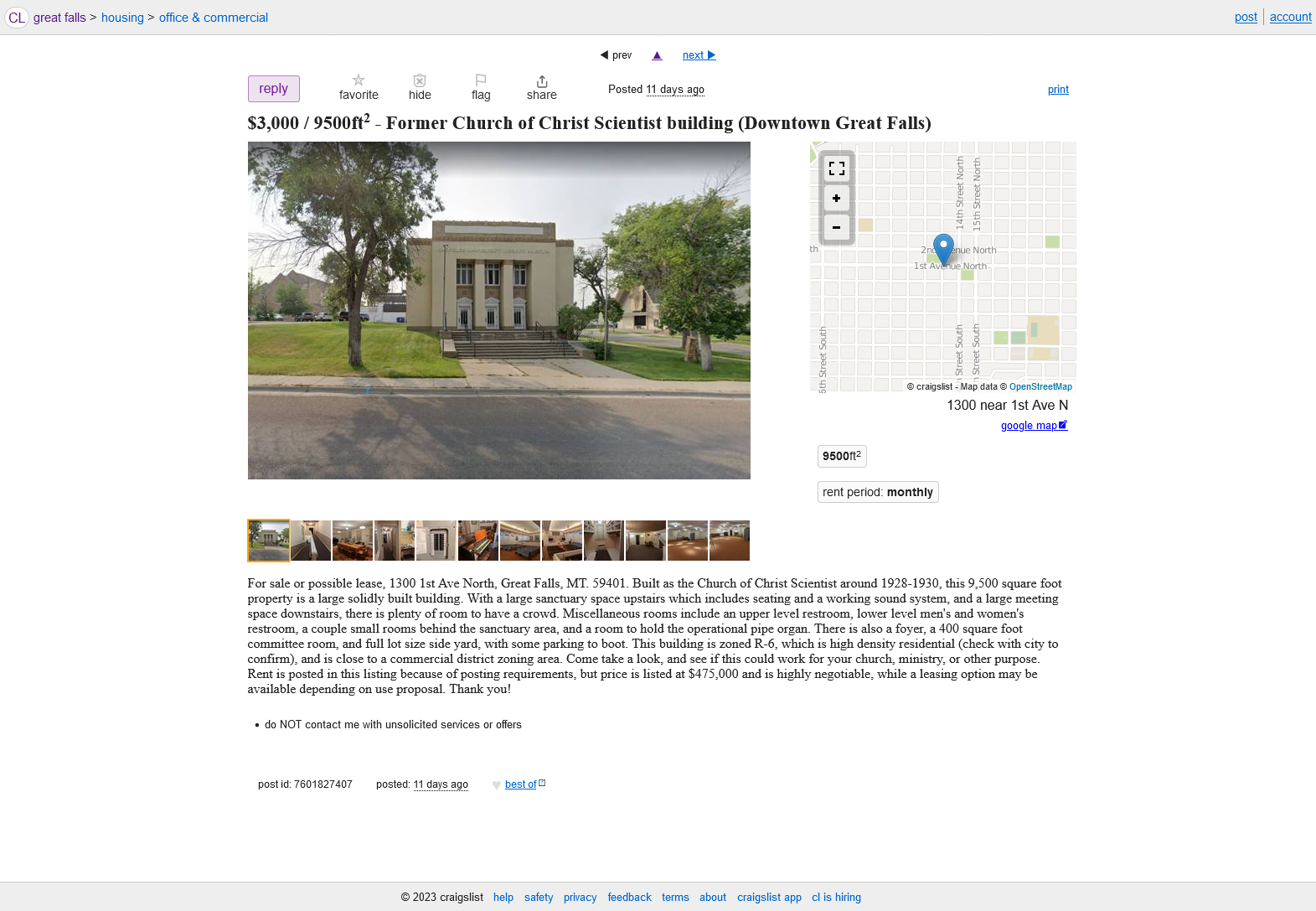
WTF406.com has written numerous posts about Republican Senator Jeremy Trebas’ commercial property on 1st Avenue North. A quick recap:
–Trebas bought property at 1300 1st Avenue North in May 0f 2022. The property was classified as a church when he bought it. Trebas’ continued to enjoy the property tax classification as a church even though he did not qualify for the exemption. His annual property tax bill was just under $550 per year.
–The building was also in violation of fire codes, because it did not have an adequate fire suppression system. Rather than complete the needed work, Trebas introduced a bill in the Montana Senate that would have exempted his property. The bill was vehemently opposed by Fire Marshals across the state and died in the legislative process.
–After the legislative session (and his failed attempt to change the law to favor his pocket book) Trebas put the building on the market for $475,000.
Despite the fact that WTF406 notified the Department of Revenue of concerns about the misclassification of Trebas’ building, it appeared that no adjustments were made by May. WTF406 wrote a formal letter to the Department of Revenue and local officials on June 1st asking that the property be reclassified and that Trebas’ property tax obligation be adjusted accordingly. In a follow-up phone call, the Department of Revenue informed WTF406 that the building had been reclassified, and that Trebas’ property tax obligation for the coming tax year would be $6,343.32. That’s quite a jump from the $535 he had been paying.
A quick review of current real estate listings in Great Falls on July 10 reveals that the building is still for sale. Right after the legislative session, Trebas was seeking $475,000. Real Estate Dot Com on July 10 lists the property for sale for $281,227. Of course we don’t have access to the details of his finances, but it seems Trebas is trying to unload an albatross around his neck. Couldn’t happen to a nicer guy!
What The Funk sent the following letter to the Department of Revenue on June 1, 2023.
June 1, 2023
Montana Dept of Revenue
Great Falls Office
300 Central Ave # 520
Great Falls, MT 59401
Re: Misclassification of Senator Jeremy Trebas’ Property
Greetings,
I am writing regarding the misclassification of property owned by Republican Senator Jeremy Trebas (through Rear View Mirror LLC) at 1300 1st Avenue North in Great Falls. We notified you months ago that the property does not appear to qualify for a religious exemption from property taxes and provided the following article which gives the relevant information and details.
As of May 28, 2023 we note that the property is still listed as exempt property on the Montana Cadastral Map, approximately a full year after Trebas purchased the property. He is currently paying $535.58 per year on a commercial property valued at $359,505. Far below what he should be paying.
We are surprised that the Department of Revenue has not adjusted his property tax classification. This is unfair to other taxpayers in the community and is depriving tax jurisdictions of revenue. Trebas also introduced a bill in the Senate attempting to exempt this property from needed repairs to bring it up to safety codes. Though the bill failed, it is quite apparent he is not above trying to play the system to his own advantage. https://wtf406.com/2023/01/jeremy-trebas-the-self-dealing-senator/
We request that you adjust his classification immediately and make sure he pays the difference for the year he has owned the property. If, for some reason, either the cadastral map or Webtax site are in error or you believe the property is properly classified as an exempt property, please let us know.
Sincerely,
WTF 406
CC: Property Tax Division Administrator, MT Department of Revenue,
Cascade County Commission, Mayor of Great Falls
Media
Below are links to our previous posts on this topic.
Montana is getting hit with a massive increase in property taxes. The finger pointing is already beginning. Republicans are quick to say it’s not their fault. Legislator Greg Hertz (R-Polson), chair of the Senate Tax Committee, has an editorial floating around the state pointing the finger at local governments and, ironically, the voters themselves. Hertz says that taxes are increasing because local mill levies have been approved to support things like schools, libraries, police, and fire protection. Shame on us citizens for supporting basic public services, which the legislature under Republican control since 2009 have consistently refused to fund.
What the Republicans don’t say is that everyone knew this was coming. Not because local levies are passing all over the state (they aren’t), but because property values have been increasing dramatically. Your property tax bill is determined by your property value multiplied by your property tax rate and multiplied again by local jurisdiction mills. Most communities have not increased mills and the property tax rate has not changed. However, in most communities, the value of property has gone up significantly. That is the driver behind these increases. But Hertz and Republicans are quick to blame the voters.
Another thing the Republicans are not mentioning is that state government has been choking local governments for years, refusing to allow them to raise funds to cover services. Nowhere is the consequence of this more apparent than Great Falls and the proposed safety levy. No matter what you think of the levy, most people agree that many basic services in Great Falls are underfunded. The chickens are coming home to roost, and the city is asking people to approve a huge property tax increase. Given this controversy, the odds of that mill levy passing have declined dramatically.
The Republicans are also failing to mention the fact that they started this legislative session with a $2.5 BILLION budget surplus thanks to the Biden administration’s COVID relief efforts. Montana Republicans claimed credit for the surplus and swept a big chunk off the table for income tax rebates, up to $2,500 for joint filers. They also gave a maximum of $500 property tax rebate. Clearly the Republican program favors the wealthy.
One time “tax rebates” are usually more about politics than tax policy. Both Governors Brian Schwietzer and Steve Bullock had rebate programs, though not as big as the Republicans this time around. But rebates don’t change the fact that Montana’s tax structure is out of whack and far too dependent on residential property tax while being generous to the wealthy and big businesses.
The best way to make our tax system better is to increase income taxes on the wealthy and big corporations. Despite the fact that Montana is a relatively poor state, ranked number 34 in median household income, we are ranked in the top five for our “business friendly” tax environment by the conservative Tax Foundation. Hmmm.
The current controversy over property taxes carries with it two very concerning items. First, Republicans have always promoted a general sales tax in Montana which only pushes more tax further down the income scale, forcing people with less money to assume more of the cost of government. Second, people’s frustration with the property tax system can lead them to support “caps” like Proposition 13 in California which has decimated public services. Such a measure failed to gather enough signatures here in Montana in 2022, but a similar measure has already been submitted to the Attorney General for the 2024 election.
Department of Revenue will be holding meetings across the state to discuss the property tax increases Find the schedule here: https://mtrevenue.gov/pad-town-halls/#local
NorthWestern Energy customers are about to get shocked with a huge increase in their electric rates if the Public Service Commission grants NorthWestern Energy’s request to increase residential rates. The public hearings are over and final legal briefs are being submitted. But, like a cancer waiting to metastasize, it has not gone away, and it will wreak havoc on the very people who can least afford it.
Don’t be fooled by efforts to minimize the impact of this rate case. Residential customers are facing a 28% increase in their rates compared to a year ago. And thanks to a “negotiated settlement” reached by the big guys (the utility, the state, and large customers) large users won’t see any increase at all. Bottom line this increase falls unfairly on small customers like you and me.
The average residential customer will have to come up with an additional $284 annually or more. Some people may be able to afford it. Some folks can go out and find another job to make ends meet but lots of people can’t do that…particularly Montana seniors. They will be choosing between paying their power bill, buying food, paying rent or purchasing medicine.
While we are waiting to hear how much residential rates will increase, large investors are buying up NorthWestern stock. On May 15 Market Beat reported that six “institutional investors” are increasing their holdings of NorthWestern stock. They are watching this rate case and they like what they see — for stockholders.
The corporate largesse doesn’t end with investors’ stock purchases. In 2022 NorthWestern CEO, Bob Rowe, received over $3.3 million in total compensation. Rowe, now retired, has been replaced by the former Chief Operations Officer, Brian Bird. In 2022 Bird made over $2.6 million. For comparison, Mark Johnson, the manager of the state’s largest electric co-op, makes a little over $450 thousand per year.
While you let that soak in, remember that large customers have cut a deal with NorthWestern Energy which lets them off the hook completely. They will be seeing no increase. We are talking about oil refineries, mining companies and large retailers, many of them owned by multinational corporations. Doesn’t seem fair, does it?
So, all that stands between small customers and an expensive and unfair rate increase is the Montana Public Service Commission. They alone have the power to stop or adjust this rate increase. In addition to all five members belonging to the Republican Party with its long history of supporting big corporations, the PSC has been a dysfunctional circus sideshow, dominated by bickering and in fighting. Commissioner Bukacek was recently quoted in the Billings Gazette saying, “This historic unprecedented increase that people are talking about, it’s $25 to $30 a month. That’s the cost of three to four dozen eggs.” Seems like it’s no big deal to her. Of course, she makes over $100,000 per year and has a medical practice on the side.
But there is cause to think the PSC might do the right thing and reject the “settlement” being proposed by some of the players. Several of the commissioners have established that they are no friends of the utility companies. Those members may be able to bring along others to build a majority. But they all need to hear from residential customers here in Montana. Call, email, write a postcard, let the PSC know that people are concerned, and people are watching.
A reminder of Republican Senator Jeremy Trebas’ dirty dealings in a commercial building in Great Falls.
Jeremy Buys a Building
In May of last year, Jeremy put up a Facebook post announcing that he bought the old Church of Christ Scientists at 1300 1st Ave N. in Great Falls through a shell company, Rearview Mirror LLC. The building was purchased at a significant discount, because an automatic sprinkler system had to be installed to bring the building up to code.
Jeremy Scams on Property Taxes
The building has been classified by the Montana Department of Revenue as “exempt” because it had been a church. Jeremy rented the building to The Break Forth Bible Church, likely thinking this would preserve the property tax exemption. Problem is it doesn’t. The exemption requires that the building be owned by a church. He paid just $267 in property taxes for the first half of 2022. This for a 9,000 foot commercial building close to downtown. The property is still misclassified by the Department of Revenue. (Don’t worry folks, we’ll contact them).
Jeremy Goes to Helena (Can You Say Self-Dealing?)
Jeremy introduced Senate Bill 195 in the Senate. The bill exempted his building from being required to have an automatic sprinkler system. The bill was opposed by Fire Marshalls across the state and was heavily amended, removing all of Trebas’ language exempting his own building.
Jeremy Puts the Building Up for Sale. . . at an Inflated Price
Now, Jeremy has put the building up for sale on Craig’s List. Sale price? $475,000!
So let’s break that number down a little. The appraised value of the building is $359,505. Keep in mind that appraisals generally assume that the building complies with building codes and other legal requirements. In other words, they do not discount for needed repairs. But the market does and WTF406 is confident that Trebas purchased the building below the appraised value. Now, after failing to change the law to benefit himself, Trebas has a financial albatross hanging around his neck. Will he find tenants for the building? Will he find someone to purchase the building at his inflated price? We think the answer will be “no” on both counts. Too bad for Jeremy.
To read about the whole story follow these links to our previous articles.
The City Commission has decided to send the Safety Levy to the ballot. Commissioners previously sought a property tax increase of 191% to fund the levy, essentially doubling the city’s budget to support this single levy. Outspoken supporters of the levy, like Commissioner Rick Tryon, quickly changed their tune when met with negative feedback from citizens. Although they’re still out of touch with what homeowners in Great Falls can afford, the safety levy is headed to the ballot, asking homeowners to approve a 65% increase to their property taxes.
How Much Would the Levy Cost You?
The city has noted that a 65% increase would come out to about $156.00 for a $100,000 house and around $300 for a $200,000 house. . A quick look at Realtor.com shows that the average home price in Great Falls is far nearer to $300,000. Using a house valued at 100,000 is a useless example of how the levy would affect most homeowners. So why is the city intentionally downplaying the expected cost to homeowners? Put simply, they know we can’t afford a 65% increase any more than we could afford their initial 191% increase.
Now the city is also looking to spend $150,000 on a private firm to advocate for the levy. That’s right, they’re spending over $150,000 of OUR tax money in an attempt to ALSO raise our property taxes by 65% Combine the hefty PR price tag with the arguably misleading housing market numbers being provided, and it seems the Commission is well aware that their ask is not practicable, affordable, or popular.
What’s the Return on Investment?
With the city seeking such a major tax increase, it’s important voters know what exactly this levy will fund. Of particular note, the levy would add two School Resource Officers (SROs) to the budget, with a total cost of $230,000 to the taxpayers. However, multiple studies have shown that SROs in no way increase the safety of schools. Rather, their presence has been shown to be harmful to the student population, particularly students of color. The National Education Association reports, “Yet research shows that SROs do little to reduce on-campus violence or mass shootings, and their presence is often damaging to students of color and students with disabilities. Having SROs in schools can actually create higher rates of behavioral incidents and spikes in suspensions, expulsions, and arrests.”
Studies also show that more police does not necessarily increase community safety. There is no indication that increasing law enforcement’s budget will result in a reduction of serious crime in our city. While police respond to crime, preventing crime is done by increasing community resources, like access to treatment programs for substance use and mental health. Do we want to focus on punishing criminals, or preventing crime from happening in the first place?
Can Great Falls Afford Higher Taxes?
In addition to concerns with the allocation of levy funds, the fact remains that Great Falls citizens are simply overtaxed and underpaid. An emerging housing crisis has already exacerbated the Great Falls housing market, and a 65% tax increase could be the final nail in the coffin for homeowners on a fixed income. Voters already approved a county safety levy last fall. Schools and other vital services also routinely rely on levies to support the increased costs of meeting community needs. If this massive safety levy were to pass, it would likely mean disaster for future levy attempts for other entities, like our schools. If education and public services deteriorate due to lack of funding, we could create an endless loop of increased crime and increased police budgets with a city that isn’t any safer.
Put simply, Great Falls citizens don’t have extra cash to support a 65% property tax increase.
Which begs the question, why is the Commission pushing dramatic property tax increases on homeowners while simultaneously giving massive tax breaks to companies like Calumet? How did the city decide our budget could forego $2.77 MILLION DOLLARS from the refinery, and then turn around and ask homeowners to pay an extra 65% on their houses? Read about the city’s massive tax-gift to Calumet here: https://wtf406.com/2022/09/county-approves-another-tax-break-for-refinery/
So which is it Great Falls? Do homeowners need to pay 65% more to fund a levy? Or are we so well-funded that we can give big-businesses massive tax breaks? Perhaps Great Falls will have fewer safety needs when none of us can afford to live here? Vote for the safety levy, and we’ll soon find out.
Billings Republican Representative Sherry Essman is proposing a “fee” to be collected by city and county governments on a variety of non-profit organizations, including churches. Essman’s bill, HB 391, was heard in the House Taxation Committee on February 8th. Sixteen opponents testified against the bill. There were no supporters.
If enacted into law, the bill would provide that tax-exempt non-profits, ranging from educational institutions to health care providers to churches, would be required to pay a fee to local governments. The fee would be based on square footage of their building, which is exempt from property tax because of its non-profit status. The revenue would be spent on public safety and road maintenance.
During the hearing, Republican Representative Scot Kerns of Great Falls questioned the bill, saying that it was inconsistent with “local control.” It seems Kerns and other Republicans pick and choose what kind of local control they care about when it comes to other bills. (WTF406 has already written a story on Kerns’ connections to religious institutions https://wtf406.com/2022/10/separation-of-church-and-state-not-for-kerns/) A thorough analysis of the impact of the bill (called a fiscal note) has been requested but was not yet available.
This bill won’t go very far. It faces opposition from some big players in politics, like non-profit hospitals (Benefis and Great Falls Clinic) and churches. Still, it shines a light on how much tax exempt property affects local government.